Few Halloween events capture the spirit of the holiday quite like a parade. Costumed crowds lining the streets, floats rolling by, giant puppets, marching bands, dancers and performers: a Halloween parade turns a whole neighborhood into a celebration. Some are small, beloved community traditions; others draw huge crowds of participants and spectators.
Here is what spectators and participants need to know, and how organizers can plan a parade that becomes a fixture on the community calendar.
What is a Halloween parade?
A Halloween parade is a community or city procession featuring costumes, floats, puppets and performers. Unlike many parades, Halloween parades often invite the public to take part, so anyone in costume can march. They range from kids' costume parades around a school or park to large evening parades through downtown streets.
Common features include:
- Costumed marchers, from individuals to large themed groups
- Floats built by community groups, schools and businesses
- Giant puppets and stilt walkers
- Marching bands, drum lines and dance troupes
- Pet costume sections
- Costume contests and awards
Tips for spectators
Arrive early for a good view
Popular parades draw big crowds. Arrive early to find a spot, especially if you have kids who want to see over the crowd.
Check the route and road closures
Organizers usually publish a route map and road closures. Plan how you will get there. Public transit or walking is often easier than driving.
Dress for the weather
Evening parades can get cold. Bring layers, and something reflective or a light for kids in dark costumes.
Agree on a meeting spot
Crowds make it easy to get separated. Choose a landmark meeting spot in case you lose each other, and make sure kids know it.
Be kind to the performers
Cheer, wave and take photos, but give marchers, floats and performers space. Keep kids and pets behind the curb or barrier line.
Tips for participants
- Register if required. Many parades ask marchers or groups to sign up in advance.
- Choose a costume you can walk in for the whole route, and check any rules about masks, props or vehicles.
- Know your staging area and time. Parades often line up well before the start.
- Bring water and comfortable shoes. Parade routes can be longer than they look.
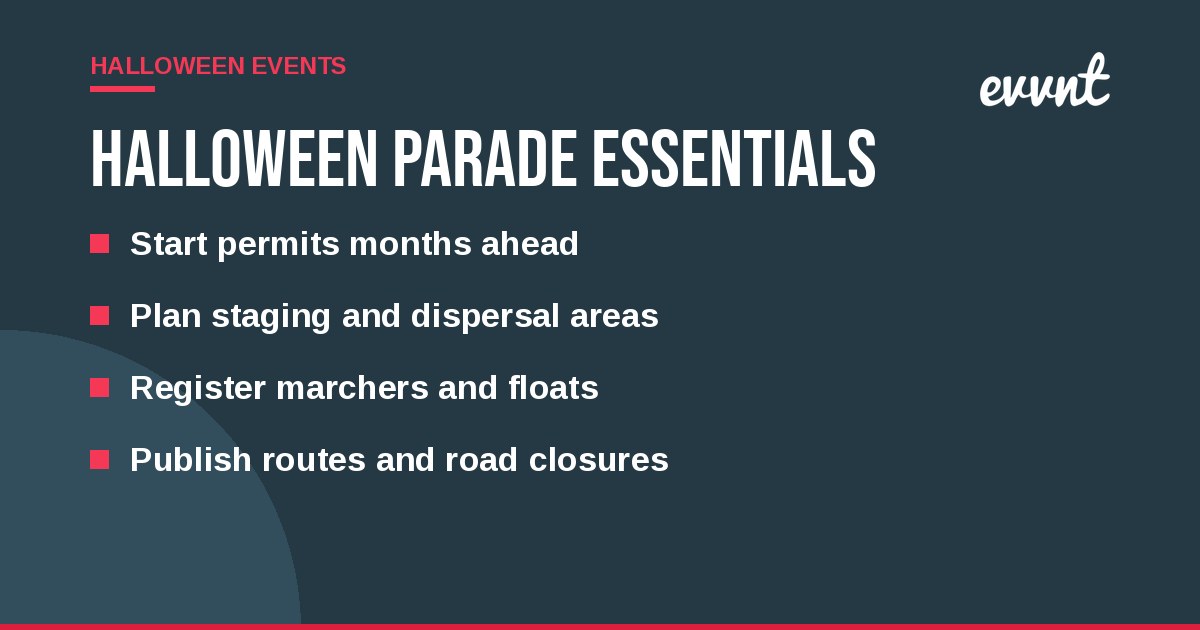
Image: Evvnt
Organizing a Halloween parade: a guide for event creators
Start with your local authority
Parades on public streets almost always require permits, road closures and coordination with police, fire and public works. Contact your local government early, often months ahead, to understand the process, timelines and costs.
Plan the route
Choose a route that is accessible, visible and safe, with room for spectators along the sidewalks and a staging area at the start and a dispersal area at the end. Consider accessible viewing areas, restrooms and first aid stations along the route.
Recruit participants
Invite community groups, schools, dance studios, bands, businesses and artists to join. Create a simple registration process with clear guidelines on float size, music, vehicles and safety. Group themes help create a memorable parade.
Line up volunteers
Parades need many hands: marshals to manage staging and spacing, volunteers along the route, and helpers at information and first aid points. Give everyone clear roles and a way to communicate.
Plan for safety
Work with authorities on crowd control, barriers and emergency access. Brief float drivers on slow speeds and safe distances, and assign walkers alongside floats. Make sure participants know your rules on throwing items into the crowd.
Add surrounding events
Many parades pair with a festival, costume contest, block party or after-party. These extend the celebration and create opportunities for sponsors and vendors.
Ticketing and registration for parades
Most parades are free to watch, but ticketing tools still help:
- Participant registration for marchers, groups and floats, with entry fees where appropriate.
- Reserved viewing such as grandstand seating or a VIP area near the judges.
- After-party or festival tickets for events around the parade.
- Costume contest entry as a separate ticket type.
- Donation options to support the parade's costs or a local cause.
Evvnt makes it simple to set up participant registration and tickets for your parade and related events.
Promoting your parade
- Announce the date and route early, and keep updating as details are confirmed.
- Share calls for participants. Every group that joins brings its own friends and families.
- Highlight the theme, big floats, puppets and performers.
- Publish practical details: start time, route map, road closures and the best ways to get there.
- Share photos and video afterward to build excitement for next year.
Evvnt can promote your parade across 40+ event sites, helping spectators and participants discover it. For more Halloween event inspiration, see our Halloween events page.
Parade planning checklist
- Permits, road closures and public safety coordination confirmed
- Route, staging and dispersal areas mapped
- Participant registration open with clear guidelines
- Volunteers and marshals recruited and briefed
- Barriers, first aid and emergency access planned
- Accessible viewing areas and restrooms arranged
- Route map and practical details published
- Promotion and participant calls running from early fall
- Photographer assigned to capture the parade
Parades grow by word of mouth. Every group that marches this year can bring more friends next year, so make participating easy, fun and rewarding.
Final word
A Halloween parade is a celebration by the community, for the community. It invites everyone to dress up, join in and share the fun. For spectators, it is a free, festive night out. For organizers, it takes careful planning and many partners, but the reward is a tradition that brings a whole town together each October.